Showing posts with label Hearing aid. Show all posts

Wednesday, March 10, 2010

How to Find Discount Hearing Aids

The American Hearing Aid Association estimates that 10% of the U.S. population experiences some form of hearing loss. Most of us know someone in our families who may be a little hard of hearing. Hearing loss is especially common in the elderly and in people who have worked many years in noise polluted environments. The elderly and those without the means to purchase expensive hearing aids will likely stick it out and simply deal with their hearing loss.

If you are considering purchasing a hearing aid, be sure to research all of your options to find the model and price range that suits your needs. You should expect to get a hearing aid for dirt cheap, but with careful planning you should be able to negotiate prices and find an excellent deal.

One way of finding discount hearing aids is to locate wholesale hearing aid dealers. A good source for wholesale products is Hearingpanet.com. This website offers accessories of hearing aids. Having a trial period is important, as this will likely be a large investment, and you need to ensure the hearing aid meets your needs.
You can also consult with your physician or audiologist to find wholesale hearing aids. It is often the case that specialists have inside information on the best places to purchase discount hearing aids. Identifying your specific type of hearing loss and the best model for you is a crucial first step. Doctors and audiologists can often refer you to a store or online market that specializes in discount or wholesale hearing aids and accessories.

If you do some research and price comparison you may be able to get great discounts on wholesale hearing aids. Pricing will vary on the make, model and features of the particular hearing aid. You need to be familiar with what features you need for your situation.

Cheap Hearing Aids

Hearingpanet.com is an excellent resource for information and hearing aid products. Through this website you can find great deals on wholesale and cheap hearing aids and accessories. This website offers micro-inner ear hearing aids . Other models are available depending upon your needs and this may be the best place to begin your search.

cheap hearing aids does not necessarily mean they will be of substandard or poor quality. It is important to be an informed and careful consumer when looking for cheap hearing aids.

As with any purchase of a substantial amount, comparing prices is essential. Depending upon your specific needs, various companies have great deals on multiple brands and styles. When buying online, make sure you understand the company's return policy.

Tuesday, March 2, 2010

Digital Hearing Aids Offer Better Hearing

Today's digital hearing aids are the most popular form of hearing amplification in use, due largely to the many advantages they have over older, analog hearing aids. Although digital models cost a bit more than analog, the improved control, clarity and reliability makes them well worth the investment.

Digital Hearing Aids Offer Better Hearing Than Analog

One of the most obvious advantages of digital hearing aids is the increased quality of your hearing. The computer chips in digital hearing aids are precisely programmed so they more accurately correct your hearing loss.

Digital hearing aids convert sound into discreet units that can be continually adjusted by the hearing aid's computer chip. This leads to improved sound quality. Each individual sound unit is precisely adjusted, and the sound components are put back together for instant listening.

The precision adjustment of digital hearing aids is a major part of their popularity. Your audiologist can precisely tune a digital hearing aid to match and work with your specific type and degree of hearing loss. They are customized and can be reprogrammed to accommodate changes in an individual's hearing.

Digital Hearing Aids Have More and Better Features

The computer chip in digital hearing aids makes it easier for the wearer to make his or her own adjustments and take advantage of a variety of options not available with most analog hearing aids. Feedback control eliminates the sharp whistle or squawk of a hearing aid when it is used too near a telephone or other device, or when you hug someone. Digital hearing aids have fewer unpleasant sound "side effects" that are common with analog devices.

Digital hearing aids also make listening more comfortable and more pleasurable. They tend to have a crisper, cleaner sound quality because of such features like multiple listening bands or channels with each band addressing a particular sound pitch. This reduces the background noise or chatter that was once common with analog hearing aids. The improved sound clarity makes users much more comfortable in situations where there are a variety of noises at varying volumes and pitches.

The latest innovation in digital hearing aids is specific voice recognition. The computer chip picks out and enhances the sound of the spoken voice while tempering background noise such as music, the wind or traffic. This digital speech enhancement is one of the most exciting advances in digital hearing aids and can add to the user's understanding of conversations in crowded or noisy situations.

Digital hearing aids also use directional microphones to improve the capture and enhancement of sounds, usually speech, in a particular direction. Most directional microphones pick up the sound directly in front of the user, in order to amplify conversational speech, and reduce the sound from behind so it doesn't interfere.

If you're considering hearing aids to help you better understand what's going on around you, be sure to consider digital hearing aids for the best sound quality, clarity and range of options.

Tuesday, February 9, 2010

Types of Hearing Aids

Since hearing aids where first developed years and years ago we have seen so many different styles and advancements in their technology. We first sore hearing aids as these big chunky things that sit behind the ear, these day you can get hearing aids which sit deep in your ear and can't be seen. Below I have a list of some of the most common hearing aids and a description of them.

Behind-The-Ear (BTH)

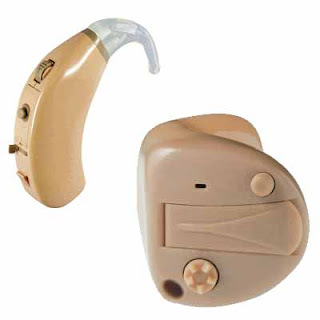
Behind-The-Ear hearing aids are largest hearing aids where by the hearing sits behind the ear. To get the incoming sound from the hearing aid to your ear, incoming sounds come into the hearing aid and than pass through a plastic tube connected to your ear. These hearing aids are often the least expensive, most reliable and house the most features and power in controlling what the hearing aid can do.

In-The-Ear (ITE)

These hearing aids are not as big as the BTH hearing aids and sit just inside the ear. These hearing aids do not have a large section that sits behind the ear and do not have a tube that runs to the ear. The ITE hearing aids are very comfortable and are also not very expensive (more expensive than BTH) which makes them a great choice if you are looking for something relatively inexpensive and of a smallish nature.

In-The Canal (ITC)

These are smaller than the ITE hearing aids and sit a bit further in the ear so they are not as noticeable. Because they are small they require a lot of skill to control however if you can find it easy to control them they are a great choice. Once again because these are smaller and not as noticeable they are more expensive than the ITE hearing aids.

Completely-In-Canal (CIC)

Completely in canal units are the smallest hearing aids to ever be made, they are so small and site so far down your ear that they require a string to remove them. These hearing aids do not have manual controls since they are so small and can be difficult to remove if you have not been shown how. However the good thing about these hearing aids is that they are totally unnoticeable and have a good sound, they are also the most expensive because they are so small.

Mini-Canals (MC)

Mini canals are great if you want something small but can't quite afford CIC hearing aids, they are the size between ITC and CIC. They also come with a very small volume wheel and are easier to remove than the CIC hearing aids. These are cheaper than the CIC hearing aids since they are a bit larger.

Post-Auricular-Canal (PAC)

These types of hearing aids are new to the market and were created in a bid to separate the processor and the receiver from each other to make a smaller hearing aid without compromising quality and features. What happens is that the small processor sits just behind the ear and than the speaker and receiver sits deep down in the canal. These hearing aids are great since they offer a lot of comfort and feature options.

Monday, December 7, 2009

Hearing aids: How to choose the right one

Hearing aid options

Some hearing aid options improve your ability to hear in specific situations:

* Directional microphones. These microphones pick up sounds coming from in front of you better than coming from behind or beside you. This technology improves your ability to hear when you're in an environment with a lot of background noise. Typically you'll have both a regular microphone and a directional microphone, so you can switch between the two types. Some hearing aids automatically switch between the regular and directional modes.
* Telephone adapters. This technology, also referred to as telecoil T switches, makes it easier to hear when talking on the telephone. The telecoil eliminates the sounds from your environment and only picks up the sounds from the telephone. Some hearing aids switch automatically when the phone is held up to the hearing aid, while others require flipping a switch. Keep in mind that this technology works only with telephones that are compatible with hearing aids — most cell phones aren't.
* Bluetooth technology. New hearing aids can transmit sound from Bluetooth devices, such as Bluetooth cell phones. These hearing aids require an interface that wirelessly picks up the Bluetooth signal from Bluetooth compatible devices and transmits the signal to the hearing aid. You don't have to hold the phone to your ear or hearing aid to hear the sounds.
* Remote controls. Some hearing aids use a remote control that makes volume control adjustments or other changes without touching the hearing aid. The remote may also make other adjustments, such as activating the directional microphone or increasing the noise reduction.

More Info Visit :- Hearing Aids, Discount hearing aids, Buy Hearing aids


Hearing Planet blog provides hearing aids doctor and hearing devices through a national network of hearing aid clinics with multiple brands,such as Hearing Aids, Discount hearing aids, Buy Hearing aids, Hearing aid, Hearing Aids for Sale, Hearing Aids Online, Digital Hearing Aids, Hearing Aid Comparisons, Hearing Aid Reviews, Compare Hearing Aid Brands, Hearing Device Models, Phonak Hearing Aids, Resound Hearing Aids, Siemens Hearing Aids, Sonic Innovations Hearing Aids, Researching Hearing Aids, Oticon Hearing Aids, Widex Hearing Aids, Starkey Hearing Aids.ns and others and independent advice to ensure the right hearing aid for you.


Friday, July 31, 2009

Types Of Hearing Problems - Hearing aids Doctor

Usually it is noticed that when a person feels problem in his ear then at the first he feels pain in inner part of his ear. It depends upon the type of hearing problem, which a user face, so in this situation one should consult audiologist for curing of hearing pain. Because a patient cannot diagnose his problem fully as compared to a specialist one otherwise ignoring such problem may cause serious position of the patient. Moreover if there is a hearing difficulties there is likelihood of recommendation of hearing aid devices by the doctor.

Types Of Hearing Problems

There are different types of hearing difficulties depending upon the different situation, these problems are mentioned one by one:

Conductive Hearing

It is characterized by time being hearing loss and pain in outer or middle of the year. Person also undergoes mild hearing loss and he might be having some loss of sight.

Sensory Hearing Loss
Sensory hearing loss is occurred due to malfunctioning of cochlea in the ear. In this case special tiny hear cells become damaged and it effects on hearing capability of person very badly as compared to conductive hearing difficulties. The person with this problem cannot distinguish among the sounds around himself.

Neural Type Of Hearing Problem:

Neural type of hearing difficulties is occurred because of problem in connection of cochlea to brain. Since it is also regarded as nerve problem as it is only the nerve which takes important sensory information from cochlea to brain so in neural type of hearing difficulties nerve is mostly effected. Sometimes this problem also occurs due to hereditary traits, which comes into light along the growth of a person.

There are also other hearing loses due to different reasons but these are very temporarily. For example when a person is habitual of listening high-pitched voices then after sometime it is observed that it becomes very difficult for him to listen comparatively lower voices.

Working Of Hearing Aid:

To get rid from different hearing loss problem one can use different hearing aids, which depend upon type of hearing loss. Different hearing devices can be different in structure but they perform same function.

Structure Of Hearing Aid

Mostly hearing devices are composed of microphone amplifier speaker and battery. Each part performs its own role for getting best quality performance. These devices are very much sensitive and only ones careless attitude can lead to loss.

Tuesday, July 21, 2009

Hearing Aids Doctor Advice - Basic Components and Functions of Hearing Aids

The basic components of a contemporary hearing aid include a microphone, an amplifier, a receiver, and a power supply.

A microphone is a transducer that converts the sound signal into electrical energy. The amplifier is a transformer that increases the amplitude of the electrical signal that is sent to the receiver. The receiver then changes the modified electrical signal back into sound energy that is directed into the ear.

A variety of microphones, amplifiers, and receivers are used, depending on the type and degree of hearing loss. The American National Standard Specification of Hearing Aid Characteristics specifies the electroacoustic tests that a manufacturer must perform and publish for each hearing aid before the instrument is shipped.1 The standard states the tolerance allowed so that the audiologist can perform the same tests to verify the performance of an instrument against specifications.

Currently used hearing aid microphones are primarily electrical devices that have good linear behavior over a frequency range of 50-6000 Hz. This range can be modified to be more appropriate for specific hearing losses.

Directional microphones have been developed that can vary with both the amplitude and the direction of the sound source relative to the microphone. They can reduce the sounds coming from the back of a hearing aid wearer compared with the sounds coming from the front by as much as 15 dB. This change can greatly improve the signal-to-noise ratio of the listener and thus the understanding of speech in the presence of noise.

Hearing aid amplifiers are transformers primarily composed of transistors that are built into an integrated circuit. These transistors provide a current source and serve a variety of functions. In these transistors, the primary function of the amplifier is to increase the power of the electrical signal received from the microphone.

Typically, hearing aids have 2 or more stages of amplification. The first stage is the preamplifier, which is at the level of the microphone. The preamplifier helps to amplify the initial input signal. At this level, the gain is relatively low.

Most amplification is supplied by the power amplifier. These amplifiers are typed in a particular class. The most common are referred to as class A, class B, and class D. They are distinguished by their power consumption, gain, and output abilities.

Each amplifier can be modified to limit the maximum output of the hearing aid. For linear amplification, the amplifier may be limited by peak clipping. This occurs when the electrical signal exceeds the maximum output of some component of the hearing aid circuit. This type of limiting causes various forms of distortion that have been found to reduce the intelligibility and the subjective quality of speech.

A hearing aid that has some type of level-dependent signal processing is termed a nonlinear hearing aid. Most nonlinear hearing aids reduce gain as input or output levels increase.

Nonlinear hearing aids are designed to amplify a wide range of sounds so that they are audible to the hearing-impaired listener without becoming uncomfortably loud. These aids usually use some form of compression circuit that reduces the gain of the instrument when either the input to the device or the output of the device exceeds a predetermined level. This process results in a comfortable amplification for the wearer and prevents the hearing aid from saturating.

Compression hearing aids can provide amplification of the speech components that are essential for intelligibility and can reduce impulsive or high-level sounds that normally cause discomfort.

The hearing aid receiver is an output transducer and handles more power than a microphone. Receivers in hearing aids are very small because of cosmetic considerations.

In general, larger receivers can supply larger output signals. Therefore, the small receivers on hearing aids may be taxed to their output capabilities.

The receiver must also be chosen to match its amplifier. A mismatch in design produces limited output and increases distortion.

Because of the receiver's open position in the external ear canal, it is vulnerable to damage from debris in the ear canal and from the aid being dropped. Manufacturers state that approximately 40% of hearing aids returned for service have damage or blockage to the receiver.

Saturday, July 18, 2009

Hearing aids doctor - Which Hearing Aid Batteries Are Right For You

Which battery do I need?

Hearing aid batteries have been standardised across the board now, and as such are fairly easy to identify. There are four sizes available, size 10, size 312, size 13 and size 675.

They are colour coded for ease of recognition. Size 10 batteries are coded with yellow labels and packaging, size 312 are coded brown, size 13 are orange and size 675 are blue.

Most of the smaller hearing devices from Phonak, Resound or Oticon will use a size 312 (brown) or a size 10 (yellow) battery. Some of the larger digital hearing instruments will use the size 13, and a few power aids such as the Oticon Sumo or the Phonak Naida will use the size 675.

As a rule, the larger the battery, the more life you will get from it and the longer you will be able to listen to your hearing instruments without needing to change the battery. Newer hearing devices, do generally tend to be smaller which is clearly desireable from a cosmetics perspective. These smaller hearing instruments tend to use 10 or 312 batteries. Try to find a quality battery brand such as Rayovac, whihc are specifically designed and manufactured for hearing aid wearers. These will most likely provide better performance with your hearing devices than other brands. You may find that some brands of hearing aid batteries will provide a recycling facility where you can send them back and these can be reused.

Tuesday, July 14, 2009

Hearing Aids doctor Advice - Didn't Hear You, Can You Repeat That

It doesn’t matter how you say it, they all mean the same thing: you didn’t hear what was just said.

I’ve been thinking recently about how often I don’t hear what someone has said and how often I ask them to repeat themselves. In some situations I will ask repeatedly, no matter how many time it takes, until I hear. In others, I will only ask once or twice. And, in others, I will not ask at all.

With family and close friends I am happy to ask repeatedly; most, if not all, of them know I am partially deaf and they are usually happy to repeat themselves until the cows come home. Sometimes, and I guess it depends on their mood, they don’t want to repeat themselves - this annoys me quite a bit, if what they just said is not worth repeating why was it worth saying in the first place?

The people I really struggle with are the quietly and soft spoken ones. Some people just refuse to speak up and it will not matter how many times I ask them to repeat it, I will never hear them properly! I find myself avoiding speaking to people who I know speak really quietly, just to avoid the hassle - I wish I didn’t do this because I’m sure it looks rude to them and I’m no doubt missing out on some good conversation. The obvious answer here is to tell them that I have trouble hearing what they say; I really don’t feel comfortable doing that and I can’t remember a time when I ever have done. I really should make the effort to start in future.

In the opening paragraph I said that in some cases I will never ask the person to repeat themselves. I used to do this a lot - I used to be too embarrassed about my hearing loss, I tried to hide it as much as possible - I would either try and guess what they said based on the odd word I’d heard or the context of the conversation or simply nod, laugh or give a short answer like “yes” or “no”. I realised some years ago that this was a stupid thing to do, I cringe at the amount of times I must have given stupid and meaningless answers. I’m sure a lot of people do this exact thing all the time, it’s an easy way out.

It’s rarely uncomfortable to ask someone to repeat themselves in a one-to-one conversation; a group conversation can, on the other hand, be very difficult. It is a good idea to position yourself somewhere where you will have the best chance of hearing; this is something you can do when you know that one person in the group is going to be doing most of the talking: the teacher at school/college, someone giving a presentation to a group, and so on. It’s not so easy when you don’t have a single person to concentrate on: when you are chatting with friends or in an office meeting, it is particularly difficult if there is also background noise such as background chatter or office air-conditioning. It is too easy to loose the conversation when you are having to listen for voices coming from all directions.
 
Thumbnails powered by Thumbshots